

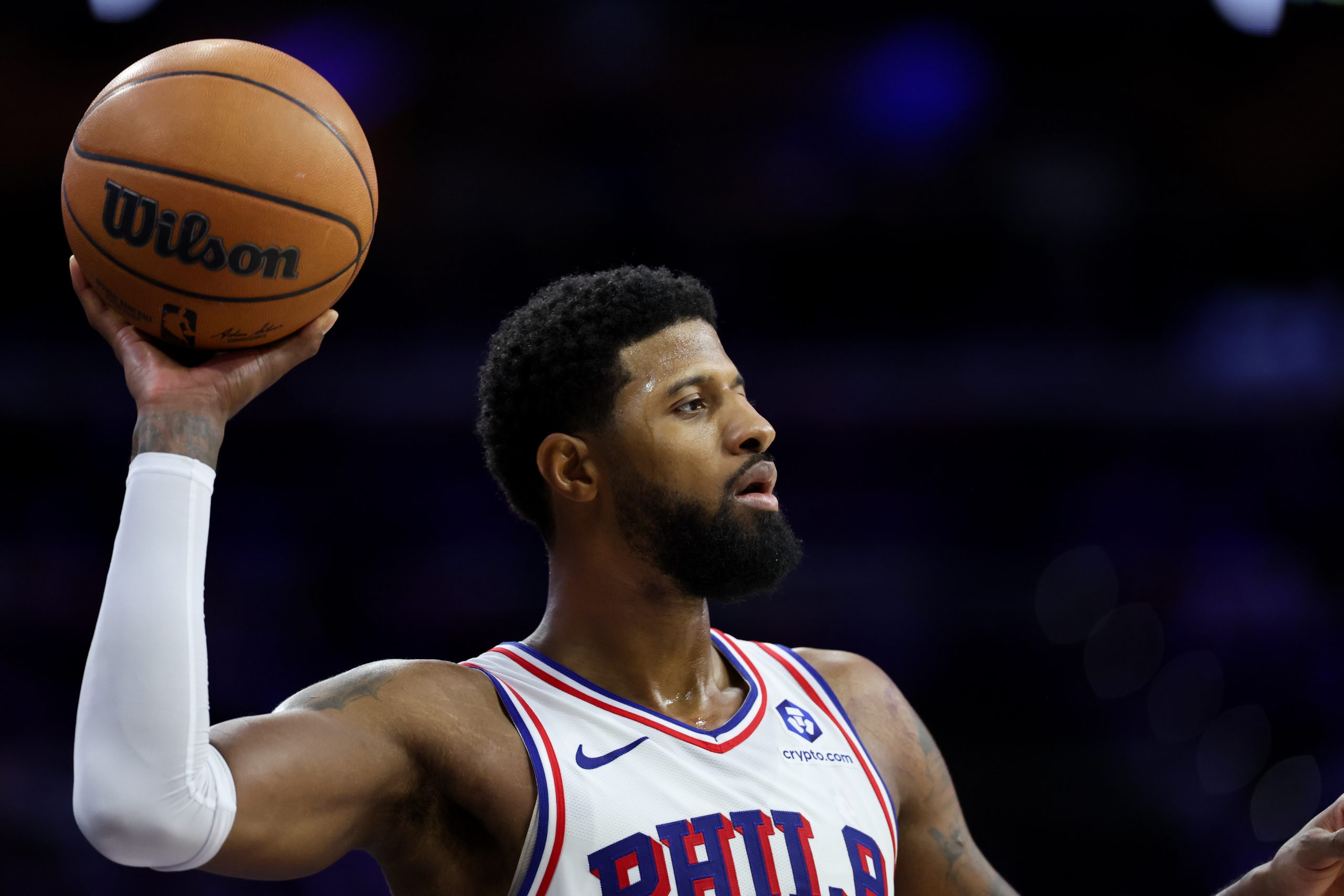
Paul George emerged as one of the league’s best two-way forwards over the past 16 years, re-emerging following a broken leg to make four more All-NBA teams over the next six seasons. The Oklahoma City Thunder and LA Clippers gave up some of the biggest trade hauls ever to acquire him. Philadelphia paid him $53-million average annual value to lure him east.
Yet when the Celtics acquired two intriguing future firsts alongside him in exchange for Jaylen Brown, the response rivaled the Luka Dončić trade reaction.
Why? First, the importance of Brown to Boston and the Celtics franchise that we’ve discussed for months since the trade went down. But George’s recent health history entering his age-36 season cast the largest scrutiny over the deal, alongside the two-years, $110.7 million left on his contract. Over the past five years stretching back to 2021-22 during his Clippers stint, George averaged 47.8 games per season. Just over half of the league’s 82.
“We like Paul, Paul’s a really good player,” Brad Stevens said in July. “We’re not every far removed from all sitting in our series against Philadelphia and watching Paul be a guy who could carry you for portions of a quarter or a half, but also player a complementary role on both sides of the floor at the highest of levels. He’s excited to come to Boston.”
George did alter his role and thrive following a 25-game suspension that accounted for the bulk of his missed games in 2025-26. The league handed it down for his violation of its anti-drug policy, George blaming an improper medication he mistakenly took while seeking mental health treatment. Upon returning in March, he shot 47.2% from the field and 41.5% from three on 8.5 attempts per game. He improved to 48.9% FG and 55% 3PT (5.7 att.) against the Celtics across their seven-game series, then regressed to 40.7% FG and 41.9% 3PT against New York in the second round.
A deeper dive into the rest of his absences revealed the routine management 30-year-old NBA players receive now. The 76ers struggled in 2024-25, warranting his late season shutdown for the final 21 games as he dealt with left adductor and knee injuries that required an injection. George also underwent arthroscopic knee surgery last summer and missed the first 12 games of this past season. He missed 19 total from that procedure as he eased his way back into the season, and another for a right ankle tweak.
Collectively across the past five seasons, George missed 50 games with a right UCL tear he underwent surgery for in his elbow, 14, including five playoff games, for a right knee hyperextension he suffered late in the 2023 season, 13 for a right hamstring strain and management that followed, and 18 across three seasons for various knee ailments not including his 2025 shutdown and surgery that followed. George has had particular trouble with his left knee. Groin, ankle, pinky, illnesses and rest accounted for the rest of his nights off between 2021-2026.
That’s 51 games for his knees, 50 for his elbow, 25 for suspension, 21 for groin and knee ailments, 13 for hamstring, five for finger, three for groin, two for illness, two for rest, two for ankle and one for his hip.
“Before the suspension, I was kind of saving myself for games because of the soreness and I wanted to be as fresh as possible going into the games,” George said last season.
There’s some hope that Boston’s significant wing depth, Jayson Tatum’s full health and scoring guards Derrick White and Payton Pritchard could allow George to manage his way through next season, thrive when available and reach the playoffs in stride like last year. While the Celtics can’t replicate a 25-game layoff, they can start Baylor Scheierman, Hugo González and others in his place regularly, and still have Jordan Walsh, Ron Harper Jr. and others able to play off the bench. In fact, getting a longer look at the team’s depth and youth factored into the Brown trade too, and Tatum often elevates those lineups tapping into depth.
George also knows his role at this point in his career, and could see his minutes, games and shot totals fluctuate in ways that wasn’t possible with Brown. Of course, the tradeoff comes against Brown’s constant availability, regular scoring output and ability to create for himself and others. George surpasses Brown’s three-point shooting ability and Boston will lean into that, but his offensive output went in the wrong direction across the board in Philadelphia, from 23.1 PPG, 4.2 APG, 2.5 TOV, 46.5% FG, 39.5% 3PT and 4.5 FTA in his final two Clippers seasons to 16.7 PPG, 4.0 APG, 2.2 TOV, 43.4% FG, 37.5% 3PT and 2.7 FTA with the Sixers.
Still, George maintained 1.03 points per possession in isolation with Philadelphia, in line with his last season in LA. His 1.18 PPP running pick-and-rolls ranked in the 96th percentile this past year (2.7 poss./game). Doing so 4.3 times per game the previous season led to a dip to 0.82 PPP (41st perc.). He posted 1.09 (94th) in 2024 with the Clippers and 0.97 in 2023 doing it 6.9 times per game. By comparison, Brown posted 0.93 PPP running 6.4 per game this past season. George is efficient, limits turnovers, committing only 2.1 per game across his past three seasons and defends well, ranking in the 58th percentile defending isolations last regular season and limiting opponents to 1.18 PPP running pick-and-rolls, 96th percentile in the regular season and 91st in the playoffs.
But can he stay healthy? And bigger picture, can he remain a player the Celtics would want to retain beyond next year, or any other would want to acquire as matching salary in a trade? Those stand as two of the biggest questions for the near and long-term Celtics future, and how we look back at the Brown trade.
“I’ve been feeling great, feeling explosive again, feeling strong again,” George said after returning from suspension last year. “I feel like I’m back on that level of being able to perform and be the focal guy and be the scorer.”
