

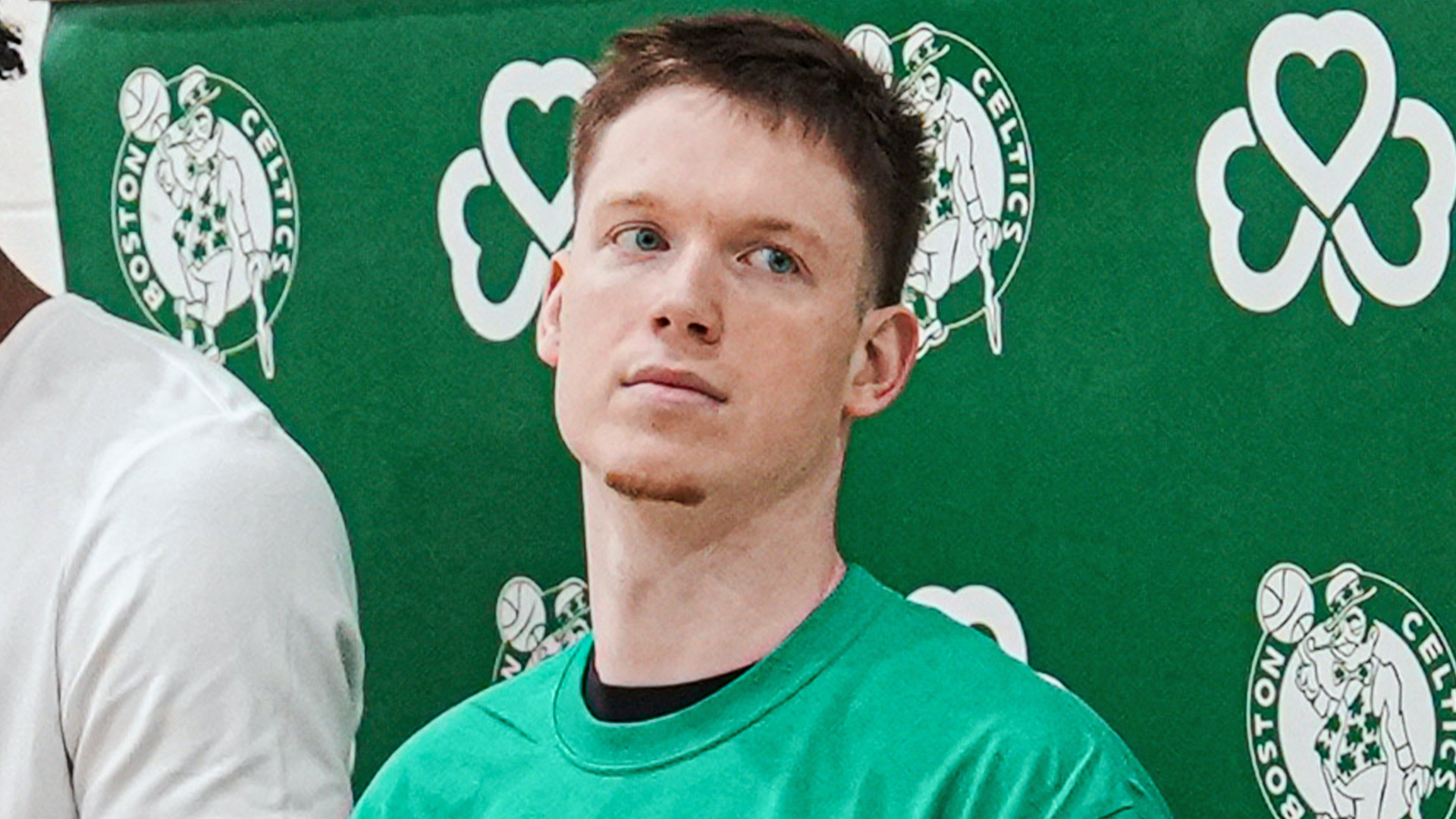
Max Shulga called Utah State assistant Eric Peterson ready to walk away from his Utah State commitment.
As Shulga awaited the school’s efforts to secure him a visa in Spain, where he played high school basketball after moving to León then later Madrid from Ukraine at 11, he considered attending St. Francis in Pennsylvania instead. Peterson urged Shulga stay patient, since he believed in the 17-year-old’s ability to play at the highest level in college basketball.
“With COVID, we didn’t know if we were going to be able to get visas for kids,” Peterson said. “We had kids going to different countries to the embassy, then travel to another country to try to catch an embassy that was open in order to get their visas. So the process was long to get Max, and I wasn’t 100% sure if we could get him over … a lot of the time, our players come over in June, and Max didn’t make it till like the end of August, so it just pushed him back a little bit.”
“We were going through a lot, like having senators write a letter to try to get him an appointment. It was quite the process and I think we got lucky with Max and Ukraine was open. He got an appointment, we had the documentation, I think we had a note from the senator and got it done.”

That initial setback sparked a five-year journey through Utah State and VCU that began with him playing only 6.8 minutes per game before missing time with COVID, and ended with the Celtics selecting him No. 57 overall last month. Shulga initially planned to get a business agriculture degree that Utah State specialized in, which he raved to Peterson could secure him a job anywhere in his native Ukraine. Instead, he became the 10th Ukrainian player drafted in NBA history in bittersweet fashion. He can’t return home to celebrate anytime soon as the Russian invasion of Ukraine continues. Shulga’s mother and sister fled the country, while his father Boris remained due to Ukrainian martial law that required men aged 18-60 to stay. Shulga and his father haven’t reunited since.
Playing through it.
Shulga emerged as a consistent contributor in 2022, when the war broke out, under head coach Ryan Odom, who took over at Utah State following Craig Smith and Peterson’s departure for the University of Utah. Peterson received permission from Utah State to check in regularly on Shulga, who understandably struggled as he watched Ukraine devastated by explosives from afar. Worse, one year after the war started, Colorado State fans repeatedly chanted ‘Russia’ while Shulga shot free throws late in their home game against Utah State.
Colorado State apologized after the display became a national news story, and both The Today Show and Good Morning America invited Shulga on to discuss the incident. Officials at Utah State saw an NIL opportunity for Shulga to draw attention toward the war, since he had special visa status as a Ukrainian to make money while studying. But he declined all of the opportunities. He didn’t want to capitalize on the conflict.
“Max really doesn’t like to talk about it,” Matt Henry, who coached Shulga at Utah State and VCU, said. “It’s not like he’ll run from it, but he’s a pretty quiet, private person … and it has affected him, obviously, but he certainly hasn’t wanted to benefit from it and that’s really a lot of Max is just not wanting the limelight, and just wanting to … be a basketball player, and obviously, it’s gonna change to a degree if he’s a Boston Celtic. I think it speaks to the things that he’s serious about. He’s serious about his relationships, and he’s serious about basketball and not really much else.”
Peterson watched Shulga for the first time in Romania, where he competed for the Ukrainian youth team in the U-18B competition, where he averaged 13 points, seven rebounds and three assists per game while shooting 53% from three, according to The Athletic’s draft guide. Further research by Peterson revealed that Shulga’s father Boris officiated FIBA games, which drew Max toward basketball. He started playing around 7-8 years old and soon lived it, watching it constantly and studying NBA players. Today, Henry recalled that Shulga can still identify random players, who they play for, where they went to college and notes about their games.
The beginning.
Shulga emerged as Peterson’s favorite player at that FIBA event, and he grew more certain when he spoke to an NBA Draft analyst there who agreed. Shulga’s passing flashed, he could shoot (39.2% 3PT in college) and he spoke four languages — English, Spanish, Ukrainian and Russian. He joined a loaded roster led by future Celtic Neemias Queta to an at-large NCAA Tournament berth. Their coaching staff planned to integrate Shulga to a consistent role mid-season, seeing him as analytically favorable to Sam Merrill, who the Pelicans selected 60th overall in the previous summer’s draft, before Shulga entered COVID protocol.
He returned the following season under Odom shot 45% from three on 40 attempts as a sophomore after Utah State veteran Brock Miller advocated for the sophomore to remain part of the plan, since he’d grow physically and mentally. Shulga’s a player, Miller stressed. Odom agreed after watching the team’s first workout. Shulga had only just turned 19 following his first year.
“There’s this kid Shulga, and he’s a freshman, he’s really young,” Henry later recalled Odom telling him. “He was like one of the youngest players in college basketball this year. He didn’t play a ton, but he’s big, he’s strong, there’s something there. He’s in the portal right now, but I’m gonna get him out. I want him to stay.”
Shulga’s breakout came as a junior, helping lead Utah State back to March Madness with 11.9 PPG, 4.5 RPG and 4.0 APG in 31 minutes per game. They lost to No. 7 Missouri, but Odom earned the VCU job and prioritized bringing Shulga with him, who emerged early in his junior year as Utah State’s best player. That didn’t prove easy, as Big East, Big 12 and Big 10 schools pursued the guard with two remaining years of eligibility. Shulga chose to stay with Odom, who became family in the US while he couldn’t reconnect with his mother and siblings until NIL money allowed him to book a vacation to Lake Como. Odom had addressed the Russia chants the way Shulga wanted, addressing it briefly the next day, rallying the team around him and moving on.
NBA prospect.
Henry began seeing some NBA potential between Shulga’s size, skill set and trajectory during his junior year. Still, he noticed scouts overlooking him as he transitioned east despite averaging 14.0 PPG, 4.5 RPG and 4.0 APG at 6-4. Evaluators inquired about him, but not as much as Henry believed Shulga’s output warranted. Alongside their geography and perhaps the level they played at in the A-10, Henry blamed the understated style that Shulga played. He took the right shots, phased out some of the more reckless pass attempts from earlier in his career and only averaged nine shot attempts through his final two seasons.
“With with so many guys like Max, (it’s) like, can he play with great players? And I’m very confident Max can play with great players,” Henry said. “That he can keep up with them in terms of their speed of thinking, and I don’t mean like play against, literally play with the Jaylen Browns and the Jayson Tatums, who are driving the offense. Max can play with those guys, and play off of those guys, and obviously, he will not be in a position to have to be the offensive creator, but in those situations where he gets a ball screen or he gets a drag, or he’s playing in transition, he has the ability to make plays.”
Shulga’s senior year earned him a transfer offer from Villanova, and a significant financial commitment that the two sides couldn’t formalize before he decided to return to VCU. That decision cemented him landing in Boston after a breakout season where he posted 15.0 PPG, 5.9 RPG, 4.0 APG and 1.8 steals per game while becoming the A-10 Player of the Year. Shulga struggled throughout the conference tournament, and the championship game against George Mason, but with VCU’s lead down to one point with roughly two minutes remaining, lined up the defender who switched onto him, waved everyone off, stepped-back and hit the game-sealing three. The win earned VCU the No. 11 seed in March, where they lost, 80-71, to BYU.
Draft night.
Henry never heard from any Celtics officials himself as Shulga progressed through the draft process. But with 1-2 weeks left until the draft, as Odom and Henry transitioned to taking over the University of Virginia basketball program, Odom received a call from Brad Stevens. The Celtics brought Shulga in for a last-minute workout and liked him. Queta and Shulga dined during his visit, and minutes into the draft’s second day, Boston agreed to trade back with the Magic from No. 32 overall and acquired an additional selection in round two. They knew two players they liked would remain in the latter stages of the draft, and Peterson didn’t fail to notice that the player Utah State once hoped could become the next Merrill went three draft positions higher.
As Peterson spoke about Shulga late last month, he received a text from Queta, who couldn’t contain his excitement about reuniting with his former teammate. Peterson told Queta to look out for Shulga as he prepares for his rookie season, which Shulga will begin on a two-way. Shulga already saw the Joe Mazzulla clips, and witnessed the same straightforward personality when he met Mazzulla in real life at a breakfast late last month, then received the warning from Queta — who’s received the toughest side of Mazzulla’s coaching.
It’s going to be hard, Queta stressed.
“He’s got like the the piss and vinegar type attitude, he’s really competitive and wants to be really good,” Peterson said. “(Shulga) just plays with the chip on his shoulder. He’ll talk some smack a little bit … there aren’t a lot of NBA players that come out of Ukraine … and I think, like Neemy (from Portugal), there’s a chip on his shoulder too with what’s going on in Ukraine.”
