

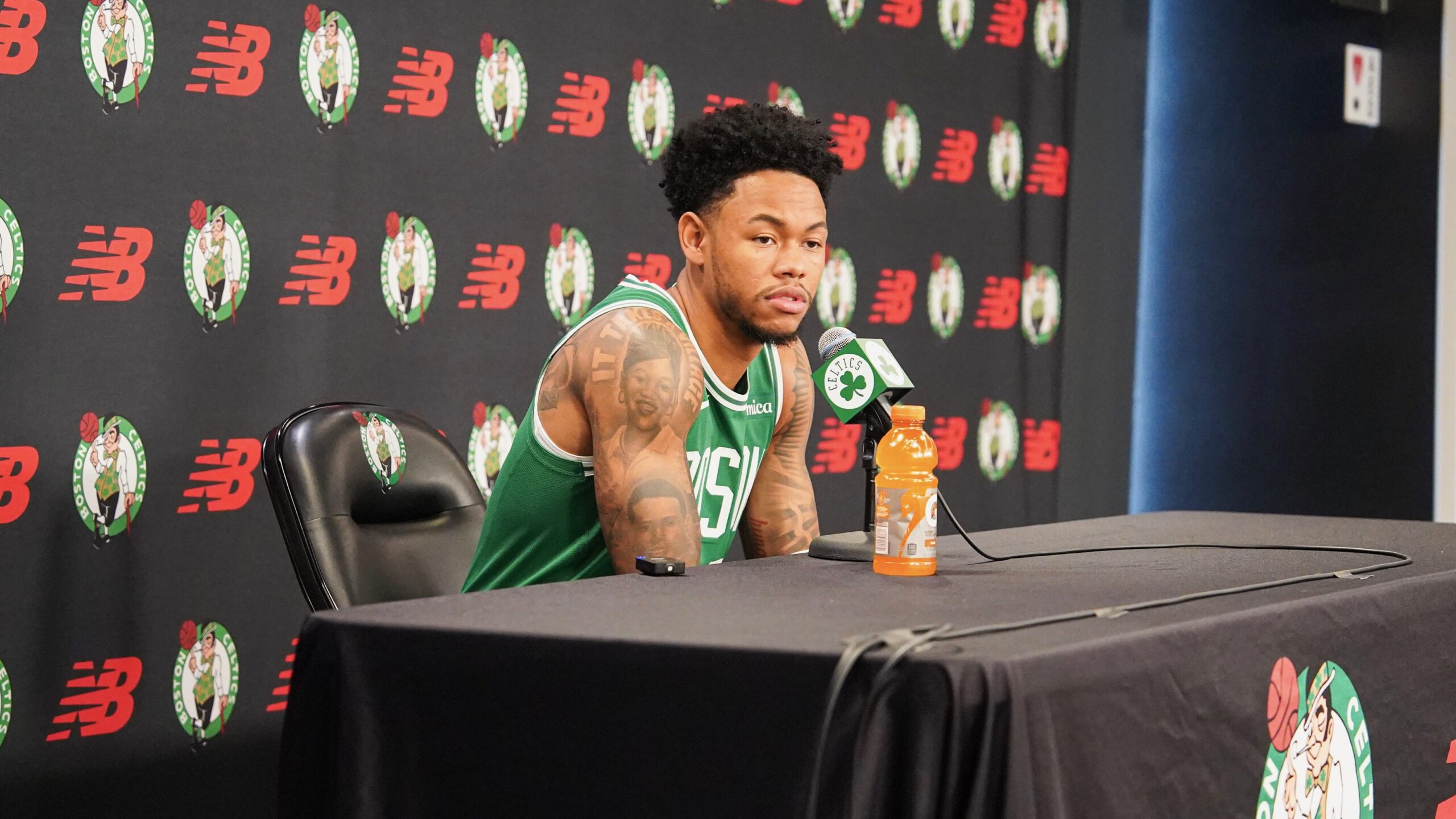
BOSTON — Anfernee Simons’ early defensive workouts with the Celtics involved stabbing at the ball, jumping passing lanes and becoming a playmaker on that side of the ball. It became his primary focus across four weeks this summer as Joe Mazzulla and his assistant coach emphasized positioning on that side of the ball. Mazzulla, who brought up Simons’ defensive issues while stressing he’s not as bad as the perception stated, did so to motivate Simons, he thinks.
“He brought it up in his Joe way,” Simons told CLNS Media on Wednesday. “He’s gonna throw jabs at you, talking smack to you, but I enjoy it. That’s what he’s challenging me with, so I’m taking on the challenge and whether he talks smack to me all day about it, I’m gonna take it in and try to be better the next day. So that’s all we’ve been doing, simple conversations like that.”
While the Trail Blazers emerged as one of the best defenses in the NBA late last season, finishing fourth with a 110.1 rating after the all-star break, Portland’s most-used lineup for the season with Simons starting posted a 116.2 defensive rating. That improved into the second half to 84.6 with Donovan Clingan in place of Deandre Ayton (40 min.). Their main lineup with Clingan and Shaedon Sharpe starting for Ayton and Jerami Grant settled in at 109.0 on defense and won their 125 minutes by 7.1 points per 100 possessions. Simons, who had a 113.4 defensive rating for the season, posted a 109.7 in the second half. He showed improvement, but acknowledged much of his struggles stemmed from needing to try harder on that end at media day on Monday.
Now, he enters an organization with the track record of having one of the league’s best defenses through a variety of personnel and coaches. But also one in a transition. Mazzulla coached consecutive second-place finishes before falling to only fourth last year. Ime Udoka oversaw the league’s best unit in 2022 and Brad Stevens finished no lower than 14th after his first season and boasted three top-five finishes. The Celtics haven’t forced turnover since the Udoka season, though, shifting toward a disciplined approach under Mazzulla that favored forcing opponents into the least efficient shots. While he emphasized never giving the ball away on offense, Boston ranked in the bottom-five of opponent turnovers per game through his first five seasons, including a last-place finish in 2024. That appears to be changing based on early comments from players at camp.
“The first things we worked on was just being a playmaker (on defense). Whether it’s stabbing at the ball, trying to steal the ball, look at passing lanes, being in the right spot,” Simons said. “That’s one of the things that we drilled for the first four weeks I was here before training camp, so those things are stuff that I never really worked on or had been taught. So I was happy that was a focus, and you can see the impact of, in those four weeks, just working on that stuff.”
Josh Minott also mentioned the Celtics trying to weaponize his athleticism on defense and urged him to take ‘calculated risks’ on the defensive end, a departure from the team’s priority in recent years. He, like Simons, mentioned doing drills he never had before, like back-peddling on close-outs. As much as the Celtics have discussed playing fast on offense to begin camp, Mazzulla wanted to see the same pace on the defensive end. They’re taking advantage of renewed athleticism, length and roster strengths that defer from recent teams. That’s the only hope for turning enormous defensive talent lost on that end from Jrue Holiday to Jayson Tatum to Al Horford and multiple rim protectors, into a strength — to play differently.
Some focuses should remain the same. Long before Mazzulla, the Celtics have excelled at limiting opponent three-point efficiency, finishing tied for first under Udoka and second in 2020. Mazzulla’s three teams finished fourth in 2023 and 2024, then third last year. They’ve tried to limit transition by pressuring the offensive glass, and since Udoka, tried to funnel more shot attempts toward the worst opposing shooters. For Mazzulla, who initially tried to limit the total number of threes opponents took, he adjusted slightly last year toward embracing more threes if they’re bad. His staff has studied league trends, and a new look on that end will reflect both roster changes and what’s working around the league.
It’s been a long time since the Celtics have struggled on defense, and finding a new identity on that side could become the biggest factor in whether Boston exceeds or falls below expectations. Mazzulla plans to lean toward taking some chances, but noted it will depend on time-and-score, personnel on the floor and where they’re at, whether in an advantage or disadvantage, within a possession. Past attempts to turn up the heat on defense didn’t pan out, and the defense thrived nonetheless. This year, it may prove necessary.
“Balancing what your roster is, what’re the strengths of your roster and how do you do that? A lot of different ways to do that,” Mazzulla said. “Everybody talks about pace, but it’s not just an offensive term, it’s a defensive term. How can you create pace defensively? How can you make guys uncomfortable? How can you make them play faster? How can you make them make more decisions over the course of a possession and over the course of the game? And then using your physicality and your activity, which I think the guys have done a good job of during the first couple of days of practice.”
