

Jaylen Brown reached 27 points in Portland last week before halftime, cruising to nearly all he would need to tie Larry Bird’s franchise record streak of nine consecutive games with 30+ points. He would reach that mark with a free throw more than halfway through the third quarter. The Trail Blazers decided to stop letting Brown burn them in an eventual Portland win, allowing him only 10 points in the second half. Then, Will Hardy took similarly drastic measures to stop him from claiming the record two nights later.
The two games that the Celtics split on their recent west coast road trip became the most significant examples this season of teams adapting to a borderline MVP first half from Boston’s star in his new role. Prior to Portland, averaged 29.4 points, 6.3 rebounds and 4.9 assists per game on 50.2% shooting (36.9% 3PT). He thrived in isolation and routinely reached his spots in the mid-range, where teams don’t guard as aggressively.
That real estate he operates from, geometrically, is a difficult one to defend, and for teams around the league, Boston’s decline from one of the league’s most lethal three-point threats proved challenging to adapt from. That’s changing, and Brown has shot below 50% in four of his last five games. Of course, the fifth was a 50-point masterpiece against the Clippers that arguably became the most dominant performance of his career.
“I think what ends up happening is when you do try to take him out of the game, he is a willing passer,” Billy Donovan said before Celtics-Bulls on Monday. “And when he does move the ball, he gets off of it and generally what it’s doing is it’s putting another player in a close-out situation and that player for them a lot of the times is either a guy that can shoot it or can put it on the floor and create. They have guys at positions that when the ball finds them, they can make the next play and they’re certainly capable enough to shoot it behind the line.”
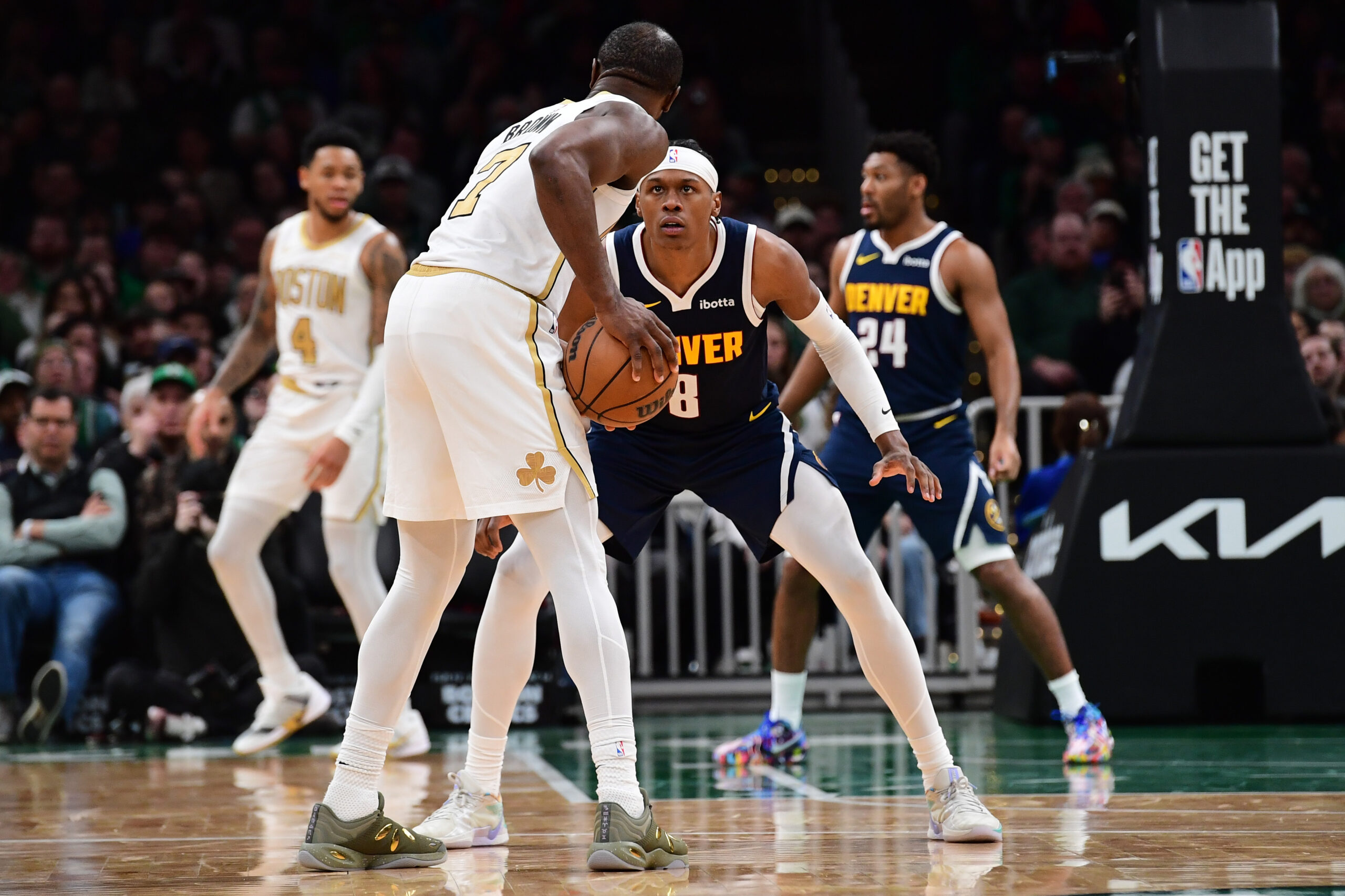
Jamal Murray and the Nuggets watched Brown’s 50-point game before traveling to Boston on Wednesday and decided to show Brown crowds. They changed how they did so, however, trying to either keep a low help defender closer to the basket or later bringing one in from the perimeter late to decrease how much time Brown would have to make a decision. Of course, Brown could counter by getting off the ball quickly following his drives and by pulling up for jump shots. He scored 19 points on 8-for-17 shooting (3-5 3PT) with the game tied at 58 at the half.
That worked for David Adelman, who preferred to let Brown and others operate in transition rather than letting the ball spray around, which happened at times when Denver grew too aggressive in its traps. Brown, surprisingly, hasn’t seen many pick-and-roll traps this season despite his success and the Celtics producing 1.04 points per possession in those sets, which ranks in the 83rd percentile of the league. Among qualifiers, 20 star players have seen more traps as a percentage of team possessions than Brown, according to Synergy. He ranked in only the 33rd percentile of players who saw the defense commit to their pick-and-roll. Portland, Utah and even the Clippers, as Brown throttled them, took a different approach.
“The Clippers had both bigs up as well,” Joe Mazzulla noticed after the west coast road trip. “You’re seeing a trend, a little bit, around the league. One, I thought he handled it well … their aggressive pick-and-roll coverages and finding two-on-ones and having great screens and making a great seam read. In a game where a guy has 50, he obviously has incredible shot-making, but I thought there were some reads he made in small-small pick and roll, and with the five. He works those reads every single day and I thought he did a good job of fighting them throughout the trip.”
Brown lost his 30-point streak in Utah but managed 10 assists passing out of pressure in the Celtics win. And while Denver committed late help defense in the Nuggets’ win and played some matchup zone, the physicality of their switching bothered him most. Brown complained about the officiating following the game, and blamed no-calls for why some of his shots looked erratic, arguing he needs consistent calls game-to-game to decide how to attack. He also called himself capable of adapting to different officiating and coverages.
He’ll need to as defenses learn the advantages to playing him more physically and in crowds. Brown committed seven turnovers against Denver, one on an offensive foul where he tried to create separation in the mid-range. He missed two free throws and fell to 77.1% at the line this season. The Nuggets got away with switching center Zeke Nnaji onto him late, and Adelman credited it as one of the keys to the game. Sometimes, he also acknowledged, none of that matter. Brown finished strong in traffic routinely and shook off several Aaron Gordon bumps on one play where Brown finished with his floater .
“You gotta hold your ground with him,” Adelman said. “He’s so strong and he gets to his spots … I thought (Nnaji) did a good job of staying down on his pump fakes, he took the physicality of the off arm and just stood his ground. I thought he was active with his hands at the right times. If somebody brings the ball down, that’s when you can really attack the ball and we did that, and I also thought guys, they timed up when we brought a second body. They have so much shooting out there, it’s gotta be at the right time where he’s spinning in his move or he’s countering, whatever it may be. I just thought the team in general did a really good job into the second half on him, but Zeke Nnaji stood out to me.”
Teams appear increasingly willing to body Brown and get away with it. They succeeded earlier this season in part, Brown fell below 30th through the end of November in free throw attempts per game before he sounded off on his totals after the Celtics’ loss in Minnesota. He attempted roughly 10 per game after through his own adjustments and those by the officials. Into early January, he’s settled at 7.2 per night, 16th in the league, while driving 17.8 times per game, which ranks third.
Elite mid-range shooting continues to counteract that and defensive coverages that still typically shy away from taking away those shots while trying to prioritize rim protection and taking away the three. So Brown has thrived, shooting 46.6% on mid-range attempts while taking the most in the league alongside DeMar DeRozan. That’s down to 35.7% over the last six games going back to Portland, however, and with more pressure surely on the way, Brown and the team’s ability to absorb it could become the biggest determiner of how Boston finishes the season.
“He had 50 last game, so don’t give him no space to operate freely,” Murray said. “When he drives, I was trying to tell the bigs, just go, just help, because he’s going to score and he’s very, very capable of doing so. I thought in the second half and the fourth quarter, we did a good job of just corralling him when he did get in the paint, making it tough for not just him, but everybody. Derrick White was shooting great pull-up threes, Pritchard’s attacking downhill. I think as a team we packed the paint a lot and we did a better job rebounding in the fourth.”
