

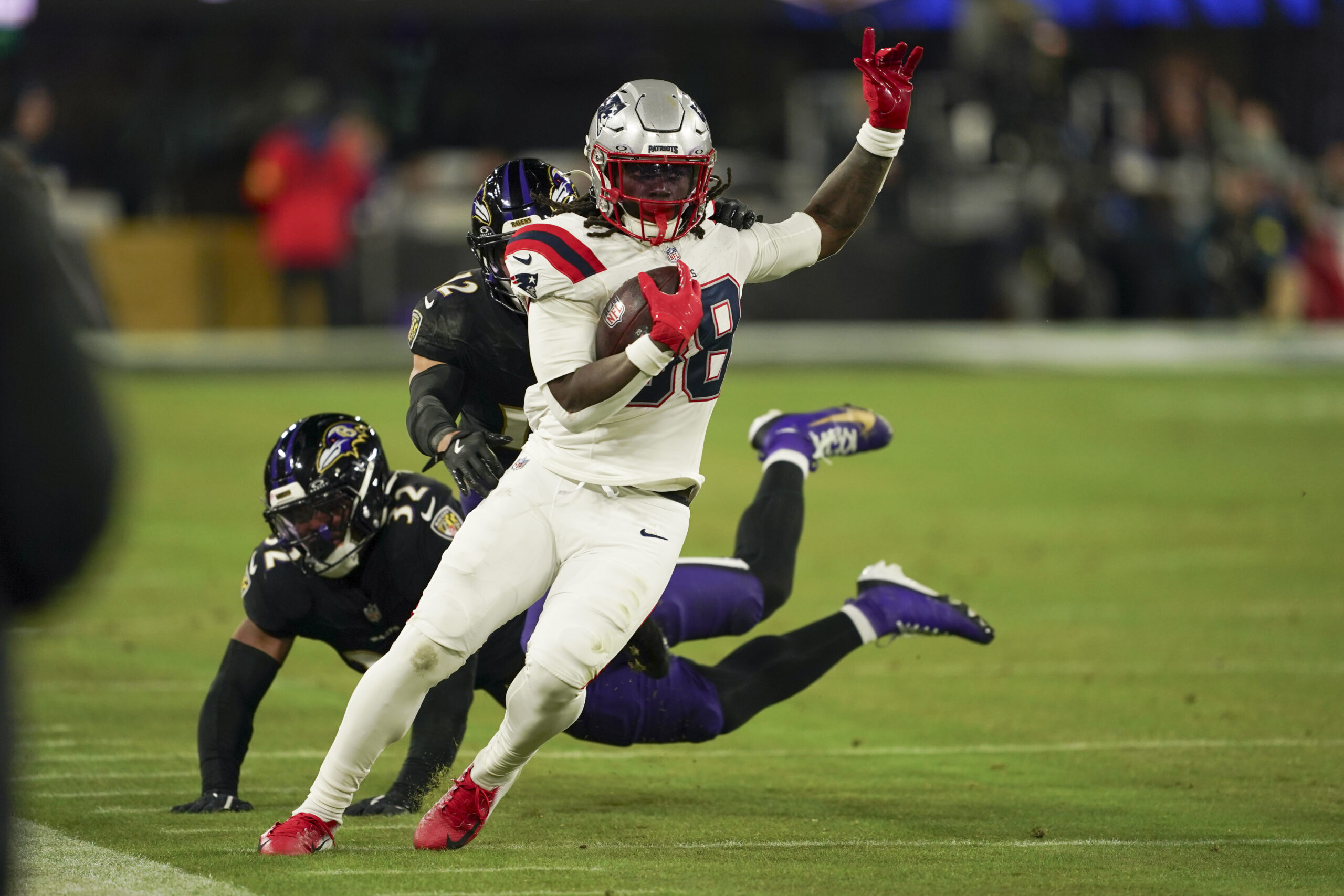
The Patriots’ ground game has pulled off an impressive 180 in recent weeks.
Through the first two months of the season, New England’s offense ranked in the bottom ten of virtually every rushing metric. Their overhauled line looked disjointed, Rhamondre Stevenson’s fumbling woes resurfaced, and TreVeyon Henderson was still adjusting to NFL speed. Making matters worse, Antonio Gibson suffered a torn ACL in Week 5 after looking like the backfield’s best player.
Henderson’s mid-season ascent brought a much-needed spark to the backfield—and led to a November Rookie of the Month nod—but boom-or-bust blocking and a toe injury to Stevenson kept the run game from being a consistent threat.
Players and coaches often referenced “time on task” when asked about these struggles, which proved to be an accurate assessment before the bye week.
The Patriots haven’t run often since Week 13, and negative plays remain a concern, but their rushing offense has been incredibly efficient over that span.

Henderson’s ascent has been crucial to this turnaround, and he’s produced like one of the league’s best backs since Week 8.

That said, the offensive line has shown noticeable improvement, especially on the right side, and Stevenson has looked as physical as ever since returning from injury.

Now, with Mack Hollins on injured reserve, Kayshon Boutte likely out with a concussion, and a playoff push on the horizon, there’s no better time for New England to lean on the run and take some pressure off their sophomore quarterback.
For a better idea of what’s fueled the ground game’s comeback, let’s dive into some of the offense’s top concepts over the last three weeks.
DUO
Duo is a downhill concept that creates vertical push by maximizing double teams at the point of attack.
This McDaniels staple is typically run from under-center with fullback Jack Westover or a third wide receiver on the field. Depth linemen Thayer Munford and Ben Brown have also served as sixth offensive linemen to provide additional push.
Backs looked like they were running into a brick wall on duo for most of this season, but it’s been successful on at least half of the Patriots’ attempts in each of the past three games. The offense hadn’t hit that mark since Week 8 against the Browns.
Duo isn’t known for generating explosives, but repeated blows have led to some big plays late in games. Take this 21-yard touchdown run from last week in Baltimore.
The Patriots come out in a jumbo set with Munford as the in-line tight end, Hunter Henry beside him at flanker, and Stevenson behind an offset Westover. The Ravens, having seen this look and play twice already, send out their 6-1 defense and load up in that direction.
Westover surges toward the left B-gap, and Stevenson presses that way to influence LB Roquan Smith. Once Smith commits, Stevenson bounces behind Jared Wilson, Mike Onwenu, and Garrett Bradbury, weaves behind a Kyle Williams block downfield, and slips two tackles to seize a late lead.
POWER/COUNTER
Power and counter are nearly identical to duo, but with linemen pulling to create a numbers advantage at the point of attack. The key difference between them is that power blocks the edge with a skill player, while counter seals the edge with a pulling lineman.
These concepts are typically paired with lighter groupings and called from shotgun, allowing McDaniels to tag additional run or pass options.
Power has been one of the Patriots’ most efficient runs, despite not being as popular as duo or zone. It’s averaged over six yards when called, easily the most among the offense’s core concepts, and it led to one of New England’s most aesthetically pleasing scores this season.
The Patriots come out in another jumbo set featuring Munford at tight end, but with Austin Hooper beside him on the right wing, Henry on the left wing, and Henderson in the backfield. The Bills counter with their 4-3 under front to create a five-man front with the strong safety creeping toward the line.
Henderson’s jab step freezes the unblocked corner, Munford and Morgan Moses put the playside defensive end on skates, and Hooper sets a solid edge for Wilson’s lead block. At the second level, Bradbury and Wilson connect on their climbs, and Munford and Moses put the their initial assignment in the middle linebacker’s lap, and Henderson shows his home run speed by exploiting the massive hole for a 52-yard score.
Counter is one of New England’s less popular runs, but it’s seeing an uptick and has led to multiple big plays.
The Giants’ defense matches New England’s three-receiver set with a 4-2 front and two high safeties, giving the offense a favorable run look. The Patriots deploy a bunch with Henry at off-ball tight end, Hollins at the point, and DeMario Douglas outside.
Douglas motions to the backfield pre-snap before simulating a sweep, and Henderson fakes a block before following pulls from Onwenu and Henry.
Backups Vederian Lowe and Ben Brown get excellent push on a combo to the backside linebacker, Onwenu lets Abdul Carter run upfield, and Henderson follows second-level blocks from Boutte and Henry. Henry’s man falls off his block late, but Henderson breaks free before finishing with authority.
Power and counter could prove to be a dangerous ace up the Patriots’ sleeve, particularly when incorporating quarterback runs and different pass concepts.
OUTSIDE ZONE
Outside zone aims to create perimeter or cutback lanes by pushing defenders toward the sideline.
New England calls outside zone almost exclusively from under-center, which provides a cleaner read for ball-carriers, but uses several different groupings.
The horizontal concept doesn’t bring the boom quite like duo or power, but it gives explosive backs like Henderson space to bring the lightning. In fact, outside zone is one of the few concepts New England has averaged positive EPA/play on this season, and
It’s also been effective with key pieces like Wilson and Will Campbell and out of the lineup, as shown on this explosive gain against the Giants.
The Patriots get a similar defensive look after sending out another bunch with three receivers, but this time, Drake Maye lines up center to set up a wide handoff.
Lowe uproots the edge, Brown and Bradbury lock up their assignments to give Henderson a lane, and Boutte cracks down hard on the safety, allowing Henderson to accelerate past the sticks. Onwenu and Moses also throw strong backside.
The interior could be more consistent blocking second-level defenders, and a fumble off Westover’s thigh thwarted a well-blocked attempt last week, but these runs feel like a big play waiting to happen.
LOOKING AHEAD
The Patriots should keep building momentum against a Jets run defense that has ranked in the bottom 10 since Week 12. DI Jowon Briggs and LB Quincy Williams have struggled to hold the point of attack, and ED Jermaine Johnson (Achilles) has been ruled out.
The offense will also feature rookies Kyle Williams and Efton Chism in much more roles down the stretch, setting the stage for Stevenson to hit New York with repeated body blows to hide a passing game that could take time to gel.
Henderson’s status is still up in the air as he works his way back from a concussion, but there’s hope he’ll be available on Sunday. If available, that one-two punch could prove to be more than the Jets can handle for 60 minutes.
McDaniels could crank up his outside zone use to exploit a depleted edge group, but as always, he’ll mix things up to keep New York on their toes.
Tougher tests await down the road, but if New England keeps building on recent success while avoiding major setbacks, it will be impossible to see the ground game as anything less than a surprise strength entering the postseason.
